What’s Actually Inside a Vape? The Chemistry of the Cloud, Explained

People tend to describe vaping with one of two phrases: “it’s just water vapour,” or “it’s basically a chemical factory in a pocket.” Both are wrong. What you are inhaling is an aerosol — a suspension of microscopic liquid droplets and gases, not steam and not smoke — and its composition is far more predictable than the second phrase suggests. A vape bottle contains four working ingredients. A small heating coil turns those four ingredients into something else. Understanding that chain is what lets you choose a device, a strength and a brand on evidence instead of hype.
This guide walks through what is actually in the bottle, what the coil does to it, what ends up in the mist, how all of that compares with cigarette smoke, and what Australian law currently requires from anyone selling you a device. It closes with a practical checklist for reducing your exposure, plus a look at the hardware range stocked by IDIBAPS if you are in the market for something new.
The one-sentence version: a vape is a small heater pointed at a liquid made of propylene glycol, vegetable glycerin, nicotine and flavour compounds. Everything else — the mist, the taste, the throat hit, and the small quantities of unwanted by-products — comes from what happens when that liquid reaches roughly 200 degrees Celsius.
1. The short answer: what is actually in a vape bottle?
Despite the thousands of brands and flavour names, the recipe is remarkably consistent. Every e-liquid you will ever buy is built from the same short list.
| Ingredient | Typical concentration | What it does |
|---|---|---|
| Propylene glycol (PG) | 30–70% | Thin carrier liquid. Dissolves oil-based flavour compounds, carries them to the coil, and contributes most of the “throat hit.” |
| Vegetable glycerin (VG) | 30–70% | Thickener and humectant. Produces the visible cloud, holds moisture in the wick, and gives a rounder, sweeter mouthfeel. |
| Nicotine | 0–50 mg/mL | The psychoactive component, in either free-base or salt form. The source of both the satisfaction and the dependence. |
| Flavour compounds | 0–10% | Esters, aldehydes, ketones and terpenes — the molecules that actually taste of strawberry, mango or tobacco. |
| Additives | Under 1% | Optional extras: benzoic acid (to form nicotine salts), sucralose and other sweeteners, menthol crystals. |
Water is the missing ingredient people expect to see, and in most retail juice it barely registers — it is the PG and VG doing the work. The four-part recipe is also why a bottle that lists “PG, VG, nicotine, flavourings” is not hiding much from you, and why the interesting questions start one step later, at the coil.
2. PG versus VG: the ratio quietly decides your draw
PG and VG are both food-safe humectants, and they are interchangeable to a point. What changes with the ratio is the texture of the draw: how much you feel in your throat, how much cloud sits in the air, and how sweet the finish tastes.
| Blend | What it feels like | Typical use |
|---|---|---|
| 70 PG / 30 VG | Sharp, high throat hit; thin vapour; fast nicotine delivery | Tobacco-forward juice and higher-strength free-base liquids |
| 50 PG / 50 VG | The all-rounder: noticeable throat hit with decent vapour | The most common blend in refillable devices |
| 30 PG / 70 VG | Smooth, cool, dense vapour; almost no throat hit | Fruit and dessert profiles in higher-power devices |
| 20 PG / 80 VG and above | Very smooth, maximum cloud, long sweet finish | Cloud-chasing builds and heavy dessert flavours |
One practical limitation: on a sealed disposable you cannot blend anything yourself. The ratio was locked in at the factory, so choosing a device is effectively choosing a fixed PG/VG balance and a fixed nicotine strength. That is worth knowing before you buy on puff count alone — a 28,000-puff device at 5% nicotine and a 6,000-puff device at 3% are not scaled-up versions of each other, they are different products with different exposure profiles.
3. Nicotine: free-base, salt, and what actually reaches your bloodstream
Nicotine is the ingredient that matters most, and it comes in two chemically distinct forms. The form determines how hard the hit lands and how much can be dissolved without the liquid turning caustic.
| Format | Typical strength | Behaviour | Where you meet it |
|---|---|---|---|
| Free-base | 3–12 mg/mL | Volatile, slightly alkaline (pH roughly 8–10). Small doses still register sharply, because the hit is felt in the throat | Refillable tanks and long-established high-strength bottles |
| Nicotine salt | 20–35 mg/mL typical | Nicotine bonded to benzoic acid, dropping pH to around 5–7. Smooth to inhale even at high concentration | Prefilled pods and nearly every modern disposable |
Absorption varies enormously with device power, puff length and airflow, but ballpark estimates put a salt device running 20–35 mg/mL at roughly 0.5–1.5 mg of nicotine per puff, and free-base juice at 3–6 mg/mL at roughly 0.1–0.3 mg per puff. A cigarette delivers around 1 mg. That is why “what strength should I start with?” has a fairly standard answer for people moving off cigarettes: the lowest strength that still satisfies the craving, which for most switchers lands around 12–18 mg/mL in free-base form or a moderate salt concentration in a pod device.
Also read labels carefully: a “5%” marking means 50 mg/mL of nicotine. It does not mean five percent of anything else.
4. Flavourings: “food grade” does not mean “safe to inhale”
Flavour compounds are the reason a vape exists, and also the least understood part of it. They are the same molecules used in confectionery, which means they are safe to eat — and mostly have never been tested for inhalation, where the route of exposure is completely different. The respiratory epithelium is not the tongue.
Three molecules come up repeatedly in the research literature. Diacetyl, the buttery compound behind the popping-corn note, is associated with bronchiolitis obliterans in workers with long occupational exposure, and the same concern applies in principle to inhaled aerosol. Acetyl propionyl, the caramel equivalent, carries a similar profile. Cinnamaldehyde, the cinnamon compound, has shown measurable cytotoxicity in cell studies.
None of this means fruit-flavoured vaping is uniquely dangerous relative to everything else. It means two things: that “food grade” on a label is a food-safety statement and not an inhalation-safety statement, and that a brand willing to publish its ingredient list and test for known problematic agents is telling you something a bargain-bin listing does not.
5. The coil: where the chemistry actually happens
Everything interesting happens in a component about the size of a grain of rice. Inside a sealed disposable it is usually a mesh coil, a resistive wire woven into a tiny net; in refillable tanks you will find cotton wick wound around a coil, ceramic coils, or mesh again. The coil material matters less than people assume: kanthal A1 (iron, chromium, aluminium), nichrome (nickel and chromium) and stainless steel all behave similarly in practice, with titanium appearing mainly in temperature-control hardware.
Heat comes from electricity obeying a simple rule, P = I²R. Current flows, meets resistance, and the resistance converts it to thermal energy. A 0.6 Ω coil at 20 watts runs considerably hotter than a 1.2 Ω coil at the same wattage, which is why high-resistance builds are the traditional choice for cooler, cleaner draws and mesh-heavy low-resistance builds favour flavour intensity and cloud over thermal gentleness.
Typical vaping temperatures sit between 180 and 250 degrees Celsius. At the low end, the liquid vaporises cleanly. At the high end, PG and VG start to break down and produce thermal degradation products: formaldehyde, acetaldehyde, acrolein and propylene oxide, in small quantities that climb steeply with temperature. A dry hit — vaping an empty device, or a wick that has not absorbed liquid — spikes the coil temperature into that territory within seconds, which is why a burnt taste is a signal to stop rather than a flavour to get used to.
Airflow is the other half of the equation. A restricted mouth-to-lung draw pushes a smaller, cooler parcel of aerosol deeper into the airway; an open, straight-to-lung draw produces a larger, warmer aerosol that carries more visible cloud. Modern devices with a dial let you move between the two, which is one of the more useful upgrades a vaper can actually make.
6. What is really in the mist?
When the coil heats the liquid, it does not create a uniform gas. What leaves the mouthpiece is a mix of droplets, gases and particles, and the proportions depend on power, coil material, liquid composition and how you vape.
| Component | What it is | Why it forms |
|---|---|---|
| Liquid droplets | Sub-micron to several-micron droplets of PG, VG, nicotine and flavour | The bulk of the aerosol; most of its mass sits in the fine particulate range below one micrometre |
| Gas-phase compounds | Volatile organics that evaporate rather than condense, including PG breakdown products | Formed by heating; the fraction that reaches the throat and lungs as gas rather than droplets |
| Thermal degradation products | Carbonyls such as formaldehyde, acetaldehyde and acrolein | High coil temperatures, low liquid supply, or both |
| Metal particles | Trace nickel, chromium and iron | Minor wear on the coil surface over extended use |
| Free radicals | Short-lived oxidising species | High-temperature oxidation of organic molecules |
High-resolution mass spectrometry has identified more than 200 distinct chemical species in typical e-cigarette aerosol. That is the single most useful number in this whole guide, because it tells you the ingredient list on the bottle is a summary, not an inventory — and that “only four ingredients” is a marketing simplification rather than a full chemical description.
7. How does this compare with cigarette smoke?
The comparison that matters most is not vape versus vape, it is vape versus combustible cigarettes, because that is the substitution many adult smokers are actually making.
| Cigarette | Vape | |
|---|---|---|
| Combustion | Yes, at 600–900 °C | No, roughly 180–250 °C |
| Tar and soot | Present in quantity | No combustion, therefore no tar |
| Carbon monoxide | Significant | Negligible |
| Carbonyls and thermal by-products | High | Detectable and generally far lower, but they rise sharply with temperature and dry hits |
| Nickel, chromium, arsenic | Delivered in cigarette smoke | Present only as trace wear particles from the coil |
| Nicotine per puff | Around 1 mg | Around 0.1–1.5 mg, depending on strength and device |
| Dose control | Fixed per cigarette | User-controlled, which cuts both ways |
| Odour and residue | Strong, clings to clothing and rooms | Faint, and dissipates within minutes |
For adults who would otherwise keep smoking, the evidence supports a meaningful reduction in harm. Cochrane’s review of vaping as a cessation tool found high-certainty evidence that vaping increases quit rates compared with nicotine replacement therapy, and population-level biomarker studies consistently show lower levels of tobacco-specific toxicants after switching. The residual risks are real but smaller: fine particles still deposit in the lungs, degradation products are still present, and nicotine remains genuinely addictive.
The counterweight is youth initiation. Discreet, fruit-sweet, high-strength products have clearly broadened the appeal of nicotine to non-smokers and minors, and the speed at which nicotine reaches the brain in salt formulations is part of why dependence can form faster than many adults expect. That is why every serious regulatory framework treats nicotine as a substance to be controlled rather than a consumer good. The other famous vaping health scare, EVALI, was traced to vitamin E acetate in illicit THC cartridges in 2019 and has no established link to regulated nicotine products.
8. What the Australian rules actually say in 2026
This is the section most online guides get wrong, so it is worth stating plainly. Under the Therapeutic Goods (Standard for Therapeutic Vaping Goods) Order 2021 (TGO 110), vaping products in Australia are treated as therapeutic goods, and the framework is strict:
- Nicotine-containing vapes are prescription-only in most cases. Nicotine above 20 mg/mL is Schedule 4 and requires a prescription from a doctor or nurse practitioner. At 20 mg/mL or below it can be Schedule 3 — pharmacist-supplied — where state and territory law permits. Nicotine above 50 mg/mL is not permitted at all.
- Permitted ingredients are limited to nicotine, propylene glycol, glycerol and water.
- Flavours are restricted to mint, menthol and tobacco under the standard, with plain packaging and product information requirements.
- Disposable devices are not covered by the standard — compliant products are refillable or closed-system devices.
- Supply is through pharmacies. Since July 2024, vaping products have been supplied through pharmacy channels, and zero-nicotine vapes are treated the same way.
- Age limit is 18, no therapeutic claims may be made, and advertising is restricted.
- From 1 July 2025, only vapes meeting the updated standards could lawfully be supplied in Australia.
The practical consequence is one most shoppers never hear stated plainly: a large share of high-puff, fruit-flavoured disposables widely sold online and through general retail has never been authorised by the TGA, and TGA testing has repeatedly found that the great majority of nicotine products on the market fail the labelling and quality requirements. Products that do not move through the pharmacy and prescription pathway are outside the lawful supply framework, and buying from them means no guarantee about what is in the liquid, what was in the coil, or whether the battery has been through any certification at all.
What that means for you as a buyer: check whether a product appears on the TGA’s list of compliant products, insist on a printed ingredient list and a batch or lot number you can query, and treat a retailer that publishes full specifications and compliance information as a better sign than the cheapest listing you will find. The range at IDIBAPS is listed with published specifications per model — battery, coil type, e-liquid volume and nicotine strength — so you can compare devices on the numbers that actually determine exposure rather than on puff count alone.
9. Nine ways to reduce your exposure
No vape is risk-free, and any honest guide should say so before offering anything else. But exposure is not a fixed quantity — it responds to device design and to how you use it.
- Run cooler, not hotter. If your device lets you lower the wattage, run it below maximum. If it does not, choose a higher-resistance build or a device with regulated power output.
- Prefer a consistent coil. A well-made mesh coil with an even wick keeps temperature stable across the life of the coil; cheap, uneven builds hot up and cool down constantly.
- Replace the coil when it tells you to. A burnt taste, reduced vapour, or a change in flavour intensity all mean the coil has had its day.
- Never hit a dry device. A dry coil can reach degradation temperatures in a couple of seconds, and that is the single worst thing you can do to your lungs.
- Prime new coils and wait after refilling. Give a new coil five minutes to saturate before the first draw, and check for a wicking hole at the base of the coil.
- Use the lowest strength that works. There is no benefit to a stronger liquid if it satisfies you.
- Take shorter, gentler draws. Long, hard draws heat the coil more and deliver more of everything per puff.
- Do not chain. Space puffs out; the coil needs time to re-wick between them.
- Keep it away from children and dispose of batteries properly. A lithium cell in a child’s hands is a genuine hazard, and end-of-life cells do not belong in general waste.
10. Choosing hardware: what to look at besides puff count
Puff numbers dominate product listings because they are easy to compare, but they are the least informative spec on the page. Two devices that both claim 12,000 puffs can deliver very different amounts of aerosol and nicotine per draw. The specs worth comparing are the e-liquid volume, the nicotine strength, the coil type and resistance, the battery capacity, and whether the device gives you any control over airflow and power.
Here is how the main lines in the IDIBAPS range compare on those figures:
| Model | Puffs | E-liquid | Coil | Hardware notes |
|---|---|---|---|---|
| GROO MAX 10000 | Up to 10,000 | 20 ml | 1.0 Ω mesh | 650 mAh rechargeable Type-C, LED battery indicator, one of the largest flavour libraries in the range |
| GROO SLIM 9000 | Up to 9,000 | 20 ml | 1.0 Ω mesh | Slim pocket profile on the same 650 mAh Type-C platform |
| SWIX 9000 | Up to 9,000 | 18 ml | Mesh | 650 mAh rechargeable Type-C, adjustable airflow, LED display, coffee and dessert-leaning flavour set |
| IGET ONE 12000 | 12,000 regular / 9,000 Turbo | 18 ml | 0.6 Ω dual mesh | 2,700 mAh Type-C, curved colour screen showing battery and e-liquid, dial for MTL to RDL airflow |
| IGET BAR PRO 10000 | Up to 10,000 | 20 ml | 1.2 Ω mesh | Non-rechargeable 2,000 mAh cell, matte shell, 25 flavours |
| ALIBARBAR INGOT 9000 | Up to 9,000 | 22 ml | 1.2 Ω mesh | Non-rechargeable 2,350 mAh cell, LED readout for battery and e-liquid level, 23 flavours |
| WALA YO 18000 | Up to 18,000 | 18 ml | Dual mesh | Rechargeable Type-C, curved colour screen, 21 flavours, 3.5% (35 mg/mL) nicotine |
| WALA POP 10000 | Up to 10,000 | 18 ml | 1.0 Ω mesh | Rechargeable Type-C, LED display, 20 flavours including five POP exclusives |
| SOEKE S9 28000 | 28,000 regular / 22,000 Turbo | 28 ml | Dual mesh | Rechargeable Type-C, smart display for battery and e-liquid level, 19 flavours |
| SOEKE S7 6000 | Up to 6,000 | 10 ml | Ceramic | Non-rechargeable, 8W stable output, and the gentlest option in the range at 3% (30 mg/mL) nicotine |
Read across that table and a pattern emerges. The gentlest experience in the range is the smallest device with the lowest strength and a ceramic coil — the SOEKE S7 at 3%. The most intense is the SOEKE S9 at 28,000 puffs and 5% salt nicotine, which is a real machine for a real user, not a default choice. The two IGET models sit in the middle with the strongest hardware in the range: dual mesh at 0.6 Ω, a high-capacity rechargeable cell, a curved screen and genuine airflow control. If you want one device that lets you adjust the draw rather than accept whatever the factory set, that is the argument for spending up rather than up and up.
11. Frequently asked questions
Is vape vapour just water vapour?
No. Vape aerosol is a suspension of fine liquid droplets containing propylene glycol, vegetable glycerin, nicotine and flavour compounds, plus gases formed while heating. It is chemically distinct from the water vapour a kettle produces.
What are the four core ingredients in e-liquid?
Propylene glycol, vegetable glycerin, nicotine and flavour compounds. Some bottles add a small amount of benzoic acid to form nicotine salts, or sweeteners such as sucralose. There is no tar and no combustion product in a bottle of e-liquid.
How much nicotine do I actually absorb per puff?
Estimates vary with device power, draw length and airflow, but broadly a salt device running 20–35 mg/mL delivers around 0.5–1.5 mg per puff, while free-base juice at 3–6 mg/mL delivers roughly 0.1–0.3 mg. A cigarette sits near 1 mg.
Is nicotine salt stronger than free-base nicotine?
Not in the sense of a harsher hit. Salt nicotine is chemically bound to benzoic acid, which lowers the pH so it can be dissolved at higher concentrations without the throat irritation that comes with free-base liquid. The result is smoother inhalation at a higher strength, which is also why it can carry a faster dependence profile.
Does PG or VG cause harm?
Both are approved for food use, and neither is treated as a primary concern at the levels used in vaping. The more relevant question is what happens when they are heated. At vaping temperatures they are largely preserved, but at higher temperatures they break down into carbonyl compounds, which is why controlling temperature matters more than the base liquid ratio does.
Are food-grade flavourings safe to inhale?
Food-grade means safe to ingest, not that it has been tested for inhalation. Certain compounds — diacetyl, acetyl propionyl, cinnamaldehyde — have raised specific concerns in laboratory work. This is the strongest argument for buying from brands that publish an ingredient list and screen for known problematic agents.
Does higher wattage make a vape harsher?
It raises the coil temperature, which increases both the throat hit and the amount of degradation product formed. Devices with regulated power output or temperature control exist precisely to cap that, and running below maximum wattage is one of the simplest ways to reduce your exposure.
How often should a coil be replaced?
Every one to three weeks of heavy use for a disposable, and roughly every one to two weeks in a refillable device. Replace on the symptoms rather than the calendar: a burnt taste, reduced vapour output, or a flavour that has gone flat are the reliable signals.
Are disposable vapes worse for the lungs than refillable ones?
Not inherently, but disposables remove the variables a vaper can control. You cannot replace a tired coil, lower the wattage, or manage the wick, and the coil-to-liquid ratio is set by the manufacturer. Refillable devices with replaceable coils give you more control over temperature and freshness, which matters for thermal by-products.
Can vaping cause lung disease?
The evidence points to vaping being substantially less harmful than smoking, but not harmless. The 2019 outbreak of EVALI was linked to vitamin E acetate in illicit THC cartridges, not to regulated nicotine e-liquids. Long-term effects are still being studied, and long-term is exactly the gap in the evidence.
What are the rules for buying vapes in Australia?
Nicotine-containing vapes are prescription-only in most cases, with lower-strength products pharmacist-supplied where state law allows. Under TGO 110, permitted ingredients are limited to nicotine, propylene glycol, glycerol and water, flavours are restricted to mint, menthol and tobacco, nicotine is capped at 50 mg/mL, and compliant products are supplied through pharmacies. Age limit is 18.
Are all vapes sold online in Australia legal?
No, and this is poorly signposted. TGO 110 has applied since July 2025, and TGA testing has found that the large majority of nicotine products on the market fail labelling requirements. Many fruit-flavoured high-puff disposables have never been authorised and sit outside the lawful supply framework. Check the TGA’s list of compliant products before you buy.
Which brand should I buy from online?
Look at what a retailer publishes rather than who shouts loudest: a full ingredient list, the nicotine strength in mg/mL, e-liquid volume, coil type and resistance, battery capacity, and a batch or lot number you can query. The IDIBAPS range lists those specs model by model, which is the standard worth holding every seller to.
Is vaping a good way to quit smoking?
For adults who already smoke, the evidence is reasonably good. Cochrane found high-certainty evidence that vaping increases quit rates compared with nicotine replacement therapy. It is not a cessation aid for never-smokers, and it is not appropriate for anyone under 18 or during pregnancy.
Conclusion
Opening up the cloud does not reveal anything sinister, but it does reveal something more useful than a scare: a short ingredient list, a known set of physical processes and a set of variables you can influence. The four ingredients are simple. The chemistry at the coil is well documented. The thermal by-products are real but controllable, and the way they are controlled is through temperature, freshness and dose — three things a vaper decides.
What you cannot control is what has been authorised and what has been tested, which is exactly why the regulatory picture matters as much as the chemistry. Understanding what is in the aerosol lets you ask better questions of any device; understanding the rules tells you which questions to ask about the seller.
Whichever way you go, the practical summary is short: pick a device with regulated output and a good coil, keep the coil fresh, never hit it dry, use the lowest nicotine strength that works, and buy from a source that publishes specifications rather than slogans. The full range of devices discussed above, with per-model specifications, is at idibaps.com.
References
- Therapeutic Goods Administration — Therapeutic Goods (Standard for Therapeutic Vaping Goods) Order 2021 (TGO 110) and related media releases on enhanced product standards for therapeutic vapes (tga.gov.au)
- Cochrane Database of Systematic Reviews — Vaping for smoking cessation (electronic cigarette review)
- Tobacco in Australia — Chapters 18.5 and 18.13: chemicals in e-liquids and aerosols, and the regulation of vapes in Australia (tobaccoinaustralia.org.au)
- Public Health England / UK Health Security Agency — evidence reviews on relative harms of vaping compared with smoking
- Nicotine salt and free-base aerosol delivery studies — published puff-delivery and pharmacokinetic literature on inhaled dose
Author: Mia Lawson, Content Editor at IDIBAPS. This article is for adults aged 18 and over. It is general information and not medical advice. If you smoke and are considering switching, speak to your doctor or pharmacist about the options available to you in Australia.
Related Articles
jaing • 8 min read
⚠️ Australia 2027: Every nicotine vape needs a TGA prescription. Non-prescription disposables are illegal. This guide is educational — not medical advice. Call Quitline 13 7848 for quit support. Do not vape if you are under 18, pregnant, or a non-smoker. 1. Quick summary What is vaping? It means inhaling an aerosol created when an electronic device heats a [...]
jaing • 16 min read
⚠️ Australia 2027: Stopping smoking is one of the highest-impact health moves an Australian smoker can make. This guide is for education only — it does not replace medical advice. Call Quitline 13 7848 for free, confidential help, or talk with your GP. 1. Quick summary How do you quit smoking in Australia in 2027? The strongest approach pairs medication with behavioural [...]
jaing • 6 min read
⚠️ Australia 2027: Nicotine e-liquid can only be obtained with a TGA prescription. Finished products are limited to a maximum of 20 mg/mL. Mixing with nicotine base at home is tightly regulated under prescription conditions. This page is educational — not medical advice. For cessation help, call Quitline 13 7848. 1. Quick summary Vape nicotine strength is simply the [...]
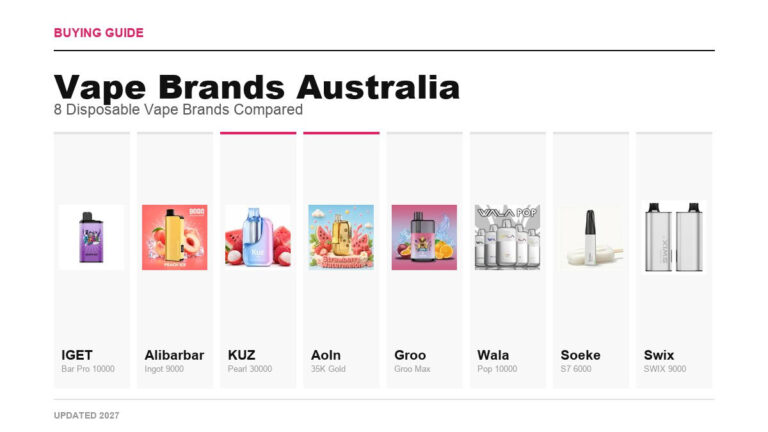
jaing • 18 min read
Australian vape retail is one of the most concentrated markets on earth. Where most countries spread shelf space across dozens of half-remembered labels, Australia has settled into a short, stable list — and for the past couple of years that list has barely shifted. For anyone buying a first disposable, that is genuinely good news. [...]
jaing • 21 min read
Let me start with the uncomfortable part: most results for “cheap IGET vapes” are not cheap IGET vapes. They are counterfeits, grey-market dropship stock, or bait-and-switch listings that rewrite the price at checkout. After six years testing these devices and watching Australian retailers come and go, the gap between a genuine bargain and a fake [...]
jaing • 23 min read
The name is doing a lot of inviting on that label, so the question is entirely fair: if it says caramel latte, does the tank contain caffeine? The answer is no. SWIX Caramel Latte Vape is caffeine-free, at zero milligrams per device. The coffee character you taste comes entirely from aroma chemistry rather than from [...]