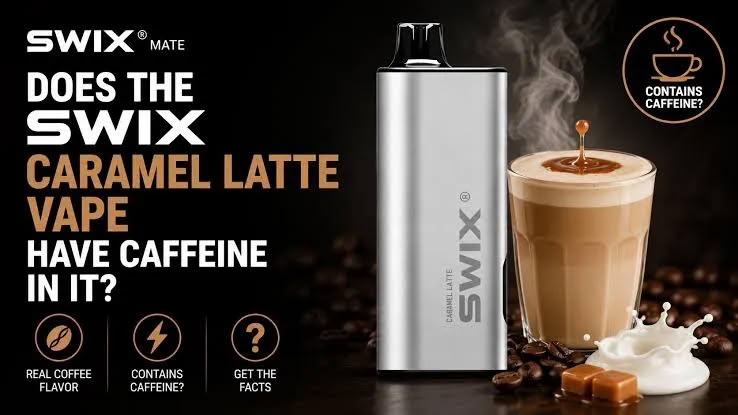
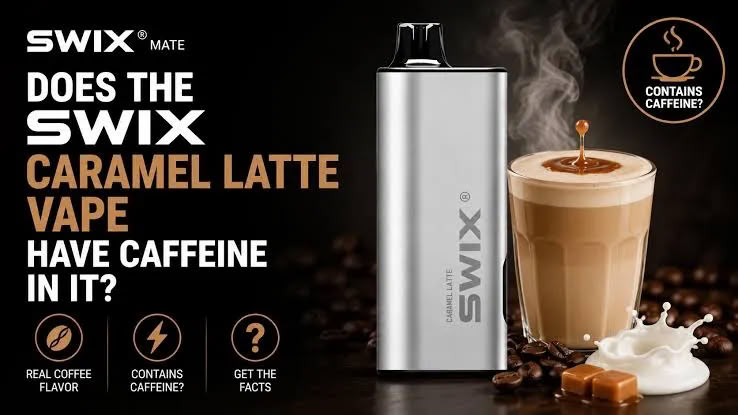
Does SWIX Caramel Latte Vape Have Caffeine? 0 mg, Confirmed by Ingredient Breakdown
jaing9 November 2026
The name is doing a lot of inviting on that label, so the question is entirely fair: if it says caramel latte, does the tank contain caffeine? The answer is no. SWIX Caramel Latte Vape is caffeine-free, at zero milligrams per device. The coffee character you taste comes entirely from aroma chemistry rather than from beans, espresso extract, or any stimulant the coffee plant produces.
The one-line answer: SWIX Caramel Latte Vape contains 0 mg of caffeine. The only stimulant in the device is nicotine at 5% (50 mg/mL). The caramel latte profile is assembled from synthetic flavour compounds, so there is no caffeine-related sleep disruption, no caffeine tolerance and no caffeine withdrawal to plan around.
It sounds like a trivial question until you notice how often flavour names get read as ingredient lists. “Strawberry” vapes contain no strawberries. “Mint” vapes contain no mint leaves. “Caramel Latte” vapes contain no latte, and for exactly the same reason they contain no caffeine. That distinction is what separates an informed choice from a coin toss, particularly if you are keeping an evening routine honest or you have been asked by a doctor to track your stimulant intake.
What follows is the full breakdown: what the manufacturer publishes, what an e-liquid is actually made of, the flavour chemistry that makes coffee taste possible without coffee, and why caffeine could not be added to a vape even if someone wanted to. We have also included the nicotine-versus-caffeine comparison that answers the follow-up question most readers really mean, which is whether this device is safe to use late at night.
Quick Answer: Does SWIX Caramel Latte Vape Contain Caffeine?
Question
Answer
Does SWIX Caramel Latte Vape have caffeine?
No. 0 mg per device.
Caffeine content
0 mg — confirmed on the manufacturer specification sheet
Coffee, espresso or coffee extract present?
No. None of these ingredients are used
What stimulant does it contain?
Nicotine only, at 5% (50 mg/mL)
Is it suitable for evening use?
Yes with respect to caffeine. Nicotine timing still matters
How is the coffee taste achieved?
Synthetic aromatic compounds such as furfuryl mercaptan, 2-methylpyrazine and guaiacol
Is this standard across the industry?
Yes. Effectively every coffee-flavoured vape on the market is caffeine-free
Every line above traces back to the same underlying fact: a flavour name describes a taste profile, not a formula. If what you were really asking was whether the caramel latte note is going to keep you awake, you can stop worrying about it. What deserves your attention instead is the nicotine strength and your own timing habits, both of which are covered in detail further down.
What the SWIX Specification Sheet Actually Says
SWIX publishes a specification sheet for the Caramel Latte variant of its 9000 series disposable. The relevant lines read like this.
Caffeine: 0 mg — not listed as an active or inactive ingredient
Coffee derivatives: none present
Stimulants: nicotine only
Flavour system: synthetic caramel and coffee aromatics, with no coffee content whatsoever
That is a clean answer, but it is worth being precise about what a specification sheet does and does not prove. It tells you what the manufacturer states is in the product and, in Australia, what must legally appear on the label under the TGA’s nicotine vaping product framework. It does not give you the concentration of every trace compound, which is why the formulation logic below matters as much as the label.
SWIX Caramel Latte — core specifications
Specification
Detail
Model
SWIX Caramel Latte 9000
Flavour profile
Caramel Latte — coffee inspired
Puff rating
Up to 9,000 puffs
E-liquid capacity
18 mL pre-filled
Nicotine strength
5% (50 mg/mL) nicotine salt
Caffeine
0 mg (zero)
Coffee derivatives
None present
Stimulants present
Nicotine only
Battery
650 mAh rechargeable
Charging
USB Type-C
Coil
Mesh coil (resistance not published)
Display
LED screen — battery and e-liquid level
Airflow
Adjustable airflow control
Activation
Draw-activated
Price
(approx.) $41 AUD at authorised retailers
Regulatory status
Schedule 4 prescription-only medicine (Australia)
Two details stand out. First, caffeine appears as a positive zero rather than merely being absent from an ingredient list, and manufacturers rarely volunteer a number for an ingredient they do not use. Second, the device is a rechargeable 650 mAh unit with a mesh coil and adjustable airflow, which is what a 2026-generation disposable looks like, and it makes the absence of a caffeine line entirely unsurprising.
Where the Coffee Note Actually Comes From
Coffee’s reputation as a flavour rests on aroma, not on its caffeine content. When you register a cup of coffee, you are mostly smelling roughly 40% volatile aromatic compounds, then 30% the balance between sweetness and bitterness, 20% mouthfeel and viscosity, and 10% temperature sensation. The stimulant plays almost no part in what anyone calls the coffee taste.
That is convenient for flavour chemists, because it means the profile can be rebuilt without the plant ever being involved. In a caramel latte the coffee layer is usually the smaller part of the structure. Caramel sweetness does much of the load-bearing work and a cream layer rounds it off, which is why a well-built caramel latte reads as authentic on the strength of its layering rather than the presence of a bean.
The layers in a caramel latte profile
Layer
Approx. share of profile
Primary function
Caramel sweetness
~40%
Sets the base note, carries the sugar-browning warmth
Coffee aromatics
~30%
Adds roasted depth and the familiar “coffee” association
Cream and milk
~30%
Provides the creamy texture and softens the finish
Rebuilding a coffee-flavoured e-liquid without caffeine simply means omitting an ingredient that was never part of the recipe. There is no removal step, because there was never an addition step.
The compounds doing the work
Everything that reads as coffee, caramel and steamed milk comes out of the flavour system, and the molecule groups used in a caramel latte are well documented in food science. The same aromatic families are approved for use in e-liquids.
Buttery mouthfeel and the rounded finish of a latte
Every molecule in that table is laboratory-synthesised. None comes from a coffee plant and none carries a caffeine structure. It is the same technique the food industry uses to produce a coffee-flavoured confectionery that contains no coffee at all.
The Full E-Liquid Composition
To answer the caffeine question properly it helps to know what a modern nicotine e-liquid actually consists of. For a device like this there are three parts: the base carrier, the nicotine, and the flavour system. That is genuinely the whole list.
1. The base — vegetable glycerin and propylene glycol
Vegetable glycerin (VG) usually takes the larger share of the carrier, somewhere around 70–80%. Its job is to produce vapour, add body and sweetness, and soften the throat hit. It is plant-derived, most often from palm or coconut, and it contains no caffeine of any kind. Propylene glycol (PG) makes up the balance, typically 20–30%, carrying the flavour compounds while adding a slightly sharper throat sensation. PG is a synthetic compound used widely as a food additive, and it contains no caffeine either.
Neither VG nor PG is a caffeine source, and heating neither of them creates caffeine. There is no chemical pathway inside a coil that turns glycerin into a stimulant.
2. The nicotine
Nicotine sits at 5% strength, which is 50 mg per millilitre of e-liquid, delivered as a nicotine salt. It is the only stimulant in the device and comes from either tobacco-derived or synthetic sources depending on the batch. Worth stating plainly: nicotine is not caffeine. They are separate alkaloids with separate chemistry, separate receptors and separate half-lives, and we put them side by side further down this page.
3. The flavour system
As covered above, everything that tastes like a caramel latte is manufactured rather than harvested. There is no coffee-derived material in the tank at any concentration, which is also why there is no caffeine for the device to carry.
Confirmed absent
❌ Caffeine — 0 mg
❌ Coffee extract, liquid or powder
❌ Espresso or cold brew concentrate
❌ Green coffee bean extract
❌ Guarana
❌ Yerba mate
❌ Theobromine or cocoa-derived stimulants
Confirmed present
✅ Nicotine at 5% (50 mg/mL)
✅ Vegetable glycerin
✅ Propylene glycol
✅ Food-grade synthetic flavour compounds
Why Caffeine Could Not Work in a Vape Anyway
Even if a manufacturer wanted to add caffeine, three separate barriers make the idea a non-starter. This is worth understanding because it explains why the answer is not merely “we did not add it” but “it could not be added sensibly”.
Barrier one: the temperature does not work
Caffeine melts at around 238 °C. E-liquid in a mesh coil is typically vaporised somewhere in the 150–200 °C range. Below its melting point caffeine simply stays solid rather than becoming vapour, so you would be heating it without delivering it. Worse, published thermal-stability work on caffeine in e-liquid has reported substantial degradation at around 180 °C, which means a meaningful share of any caffeine present would break down in use rather than ever reaching the user.
Barrier two: lungs do not absorb caffeine efficiently
Caffeine is a hydrophilic molecule. Swallow it and it travels through the digestive system into your bloodstream with near-total bioavailability. Lung tissue, by contrast, is built for lipophilic compounds, which is precisely why nicotine — absorbed at roughly 80% efficiency when inhaled — works so well. Caffeine delivered by inhalation has been measured at well under 10% bioavailability. Lung membranes are simply not set up to move caffeine across.
Barrier three: it would wreck the flavour
Pure caffeine is intensely bitter, closer to quinine than to anything found in a coffee cup. Matching a single cup of coffee would take a concentration somewhere in the range of 50–100 mg/mL of e-liquid, which makes the vape genuinely unpleasant to draw on and would overwhelm the caramel and cream notes the flavour exists to deliver.
What the research literature says
The small body of academic work on caffeine delivery by e-cigarette has been consistent across three findings. Trials on caffeine-infused e-liquids have reported that only a small fraction — in some trials under 5% — of the added caffeine reaches the bloodstream. Separate thermal-stability work has measured significant caffeine degradation at vaping temperatures. And comparative pulmonary absorption studies have repeatedly found nicotine absorbed far more efficiently than caffeine, with caffeine landing in the single digits as a percentage.
The practical read is straightforward. A caffeine vape would be an ineffective, bitter, thermally unstable route to a stimulant that works perfectly well by other methods. No manufacturer has a commercial reason to build one, which is why the rare experiments that surfaced in the mid-to-late 2010s quietly disappeared from the market.
Nicotine vs Caffeine: Side by Side
Most people asking about caffeine are really asking something else: is this going to affect my sleep, or my heart rate? So here is the two-column answer.
Attribute
Nicotine (present in the vape)
Caffeine (not present)
Chemical formula
C₁₀H₁₄N₂
C₈H₁₀N₄O₂
Classification
Alkaloid stimulant
Xanthine stimulant
Primary source
Tobacco plant (Nicotiana tabacum)
Coffee, tea and cacao plants
Mechanism
Nicotinic acetylcholine receptor activation
Adenosine receptor blockade
Effectiveness when inhaled
~80% lung absorption
<10% lung absorption
Typical alertness effect
Moderate
Strong
Heart rate effect
+5 to +10 bpm
+10 to +15 bpm
Blood pressure effect
+5 to +10 mmHg
+10 to +20 mmHg
Anxiety potential
Low to moderate
Moderate to high
Dependence potential
High
Moderate
Half-life
~2 hours
~5 to 6 hours
Sleep disruption
Mild to moderate
Significant
What this means for you
Because caffeine is not in the device, the “will this keep me awake” worry is answered. Nicotine is a genuine mild stimulant with a two-hour half-life though, and that is the factor worth planning around instead. If you use the SWIX Caramel Latte in the evening, leaving roughly a one to two hour gap before bed gives nicotine time to clear and keeps the device in the pleasant late-evening zone rather than the stimulating one.
Other stimulants — also zero
❌ Caffeine — 0 mg
❌ Theobromine — 0 mg
❌ Guarana — 0 mg
❌ Yerba mate — 0 mg
SWIX Caramel Latte delivers nicotine stimulation and nothing else. It is a nicotine product that happens to taste like coffee, not a coffee product in vape form.
Six Myths About Coffee-Flavoured Vapes
Myth 1: “A coffee-flavoured vape must contain caffeine”
There is no link whatsoever between a flavour name and a stimulant. Coffee-flavoured vapes are built from aromatic compounds that reproduce the roast, the caramel and the milk. It is the same relationship as artificial strawberry flavour to an actual strawberry. The SWIX specification sheet confirms 0 mg.
Myth 2: “I feel more awake after vaping a coffee flavour”
That feeling comes from nicotine and from expectation. Nicotine at 50 mg/mL provides real mild stimulation, and coffee aroma carries strong learned associations with waking up. Even if caffeine were present at the levels seen in experimental products, absorption through lung tissue is far too low to produce a meaningful stimulant effect.
Myth 3: “Manufacturers sneak caffeine in for marketing”
There is no incentive to do so. It would breach TGA approval requirements, it would be thermally unstable, it would be bitter enough to damage the product’s own flavour profile, and it would create dual-stimulant safety liability for no consumer benefit. Independent ingredient analyses consistently find zero caffeine across coffee-flavoured devices.
Myth 4: “It gives you the same energy boost as a coffee”
A 250 mL caramel latte from a cafe delivers somewhere around 75–150 mg of caffeine. The SWIX device delivers none. Any energy effect is nicotine stimulation plus expectation. If you want caffeine, drink it — there is no reason to believe a vape can substitute.
Myth 5: “Coffee-flavoured vapes wreck your sleep because of caffeine”
Not this one, and not any mainstream coffee-flavoured vape. There is no caffeine to disrupt sleep architecture. Nicotine’s much shorter half-life means evening use is manageable with sensible timing.
Myth 6: “Most vapes contain some caffeine”
The overwhelming majority contain none at all. Caffeine addition was always a niche experiment and it never reached mainstream catalogues. SWIX, IGET, ALIBARBAR, HQD, Puff Bar and Elf Bar coffee lines are all caffeine-free, and across the full range we stock — GROO, IGET, ALIBARBAR, WALA, SWIX, AOIN and SOEKE — no product lists caffeine as an active or inactive ingredient.
Vaping at Night: What Actually Matters
Nighttime vaping is a genuine category of concern, and separating the two stimulants makes it considerably easier to reason about.
The caffeine side: no concerns
There is no adenosine receptor blocking, no delayed sleep onset, no reduction in REM sleep and no next-day grogginess attributable to caffeine. Those effects are simply unavailable, because the compound is not present. If you have been steering clear of coffee-flavoured vapes specifically over caffeine, that particular reason no longer applies.
The nicotine side: worth timing
Nicotine is absorbed quickly and clears in roughly two hours. For most adult users the effect on sleep is small, but it is not zero. A few habits that help:
Finish your last session one to two hours before you intend to sleep
Avoid long chain-vaping immediately before bed — it stacks the nicotine spike rather than spreading it
Track your own response; sensitivity varies considerably between individuals
Keep the timing consistent day to day, which makes the effect easier to predict
The Regulatory Position in Australia
Nicotine vaping products in Australia are regulated as therapeutic goods. They are listed in Schedule 4 of the Therapeutic Goods Regulations, which makes them prescription-only medicines, and every legally sold device must carry a compliant ingredient label and an Australian sponsor holding the appropriate approvals. That is a stricter regime than most countries operate, and it has a direct bearing on the caffeine question.
What Schedule 4 permits
✅ Nicotine — up to 100 mg/mL in liquid preparations, with 20 mg/mL the commercially available ceiling
✅ Vegetable glycerin
✅ Propylene glycol
✅ Approved food-grade flavour compounds
What is restricted or prohibited
❌ Vitamin E acetate and other vitamin additives
❌ Pharmaceutical substances other than nicotine
❌ Unapproved stimulants, including caffeine without its own approval
❌ THC and CBD
❌ Diacetyl
❌ Heavy metals such as lead, cadmium and arsenic
Where caffeine sits
Caffeine is not approved for use in e-liquids in Australia. It would need its own therapeutic goods approval, additional toxicological data and a safety assessment covering combined nicotine and caffeine exposure — none of which is a trivial exercise for a manufacturer, and none of which is worth the cost for an ingredient that would not work. TGA-approved e-liquids, including this one, are built without it.
Taking caffeine out of the picture removes a specific set of concerns — though not every concern attached to the device.
What zero caffeine means for you
No caffeine-related anxiety. Caffeine triggers anxiety in roughly 10–15% of people. That group carries no risk from this device.
No caffeine tolerance. Daily caffeine use builds tolerance and withdrawal headaches. Vaping does not touch that system, so your coffee or tea habits stay yours to manage independently.
No caffeine withdrawal on cutting back. If you reduce your vaping, any discomfort you feel is nicotine withdrawal, which has a different management plan.
No stacked cardiovascular load. Caffeine and nicotine together are additive on heart rate and blood pressure. With caffeine removed, there is a single stimulant in the picture rather than two.
No caffeine-medication interactions. Caffeine interacts with a range of stimulants, some antibiotics, bronchodilators and antidepressants. None of that applies here.
Conditions where zero caffeine is genuinely useful
Anxiety disorders — caffeine reliably worsens symptoms; here there is none
Heart arrhythmias — one fewer stimulant on an already sensitive system
GERD and acid reflux — caffeine is a common trigger, and it is absent
Insomnia — no caffeine-driven sleep architecture disruption
Pregnancy — no caffeine exposure from vaping
The nicotine caveat, stated plainly
Zero caffeine is not the same as harmless. This device contains 50 mg/mL nicotine, which is addictive, raises heart rate and blood pressure, and is not recommended for non-smokers, pregnant women, or people with cardiac conditions. Its legitimate use is as a smoking cessation tool for adult smokers. If you vape nicotine during pregnancy, speak to your obstetrician rather than relying on the caffeine-free framing.
Real Caramel Latte vs SWIX Caramel Latte 9000
Component
Cafe caramel latte (250 mL)
SWIX Caramel Latte 9000
Caffeine
75–150 mg
0 mg
Coffee
Actual espresso shots
Synthetic coffee aromatics
Caramel
Real caramel syrup
Synthetic caramel aromatics
Milk
Dairy or plant milk
Synthetic cream flavouring
Sugar
~35 g
0 g
Calories
~240 kcal
<1 kcal for the device
Stimulant
Caffeine
Nicotine (50 mg/mL)
Duration of stimulant effect
5–6 hours
~2 hours
Flavour accuracy
Original
Strong replication, around 7.5–8/10
The replication is convincing enough that most vapers stop thinking about coffee as a source and simply enjoy a caramel dessert vape. What you are not getting is the caffeine, the sugar load or the nutritional content of dairy. If you want a wake-up boost, the drink still wins on that front; if you want a sweet caramel profile without 35 grams of sugar, the vape does that better.
How to Check the Caffeine Content Yourself
You do not have to take anyone’s word for it, including ours.
Read the manufacturer specification. Look for an explicit caffeine line. Reputable brands publish a zero because the coffee flavour name invites the question.
Read the physical label. Australian nicotine vaping products must carry a compliant ingredient list under TGA requirements. Caffeine is not on it.
Ask a licensed retailer. Australian vape retailers are obliged to supply ingredient information for the products they sell. A question of “does this contain caffeine?” should get a straight answer.
Check the retailer’s own product listings. Our full SWIX specifications and flavour lineup are published at https://www.idibaps.com/.
Request third-party analysis if you need certainty. Reputable sellers will point you to where independent testing can be commissioned.
Other Coffee-Flavoured Vapes — Also Zero Caffeine
The zero-caffeine position holds across the coffee-flavoured category, not just for this device:
Product
Caffeine
SWIX Caramel Latte
0 mg
ALIBARBAR coffee flavours
0 mg
IGET coffee and latte flavours
0 mg
HQD coffee flavours
0 mg
Puff Bar Café Latte
0 mg
Elf Bar Café Latte
0 mg
Historically a handful of small operators experimented with caffeine-infused e-liquids between roughly 2015 and 2018. Those products drew poor reviews, ran into regulatory bans in several markets, and had no published safety data for combined stimulant use. None of them survived commercially. What remains is a category in which coffee flavour and caffeine are entirely separate ideas.
Frequently Asked Questions
Does SWIX Caramel Latte Vape have caffeine?
No. It contains 0 mg of caffeine. The caramel latte taste is produced with synthetic aromatic compounds — coffee, caramel and cream flavour molecules — and there is no coffee, espresso, coffee extract or caffeine anywhere in the e-liquid. This is stated on the manufacturer specification sheet and is consistent with TGA ingredient labelling requirements.
Will SWIX Caramel Latte keep me awake at night?
With regard to caffeine, no — there is none, so no caffeine-related sleep disruption is possible. The device does contain nicotine at 50 mg/mL, a mild stimulant with roughly a two-hour half-life. A sensible approach is to finish your last session one to two hours before sleep, avoid chain-vaping straight before bed, and adjust if you still feel wound up. Individual nicotine sensitivity varies, so track your own response rather than assuming.
Will SWIX Caramel Latte give me an energy boost like coffee?
No. A 250 mL caramel latte from a cafe contains roughly 75–150 mg of caffeine; this device contains none. Any increase in alertness you notice will come from nicotine, which is a genuine but much milder stimulant, and possibly from the placebo effect of tasting coffee. If you want a caffeine-driven focus boost, a drink remains far more effective — inhaled caffeine is poorly absorbed.
Why does it taste like coffee if there is no coffee in it?
Because coffee flavour is mostly aroma. Compounds such as furfuryl mercaptan (roasted note), 2-methylpyrazine (nutty, earthy note) and guaiacol (smoky, burnt character) reproduce the aroma of roasted coffee at concentrations that are entirely safe to vaporise. Layered with caramel compounds such as furaneol and maltol, and cream notes such as gamma-decalactone, they build a convincing caramel latte profile with no plant matter involved.
Is it safe to vape a coffee flavour if I am sensitive to caffeine?
There is no caffeine exposure from this device, so caffeine-related anxiety, reflux, arrhythmia triggers, insomnia and pregnancy caffeine restrictions are all moot. Nicotine remains present and carries its own separate considerations, so if you have a heart condition or are pregnant, speak to your doctor before using any nicotine product.
Can I drink coffee while vaping SWIX Caramel Latte?
Yes. Because the vape contains no caffeine, there is no stimulant interaction to manage and you can keep your coffee intake completely separate. Do keep an eye on combined cardiovascular load if you are consuming both nicotine and caffeine in the same session — both raise heart rate and blood pressure, even though neither compounds the other chemically.
Do any coffee-flavoured vapes contain caffeine?
Effectively none do. Caffeine melts at around 238 °C while e-liquid vaporises at roughly 150–200 °C, so it will not vaporise cleanly. It is also hydrophilic, so lungs absorb it poorly — under 10% compared with roughly 80% for nicotine — and it is intensely bitter, which would destroy the flavour profile. On top of that it needs separate regulatory approval in Australia. The rare experimental products from the mid-2010s have all disappeared.
How much nicotine is in SWIX Caramel Latte?
5% strength, which is 50 mg/mL of nicotine salt — a standard concentration for the Australian market. Nicotine is a stimulant and an addictive substance, distinct from caffeine in chemistry and effect, with a shorter half-life of around two hours. It is intended as a smoking cessation aid for adult smokers and is not recommended for non-smokers, pregnant women, or people with certain heart conditions.
Is it safe to vape SWIX Caramel Latte during pregnancy?
The caffeine half of that question has a clean answer — there is none, so no caffeine exposure. The nicotine half does not. Nicotine crosses the placenta and is associated with developmental risks, and vaping is not recommended during pregnancy regardless of flavour or caffeine content. Please raise this with your obstetrician or GP rather than making a judgement call on your own.
Does SWIX Caramel Latte contain sugar or calories?
Effectively none. The sweetness comes from aromatic compounds rather than sweetener, so a device runs about 0 g of sugar and under 1 kcal in total, compared with roughly 35 g of sugar and 240 kcal in a cafe caramel latte. That makes it a practical option for anyone managing sugar intake — though the nicotine content remains the deciding factor for most people.
Does the coffee flavour make me crave actual coffee?
It can, since aroma drives flavour craving and the association with coffee is strong. The reassuring part is that no physical caffeine need is being created. You are satisfying a sensory preference, not a physiological dependency, and nothing about this device builds coffee tolerance or produces caffeine withdrawal symptoms if you stop.
Final Verdict
Does SWIX Caramel Latte Vape have caffeine? No. Zero caffeine, confirmed.
Having worked through the specification sheet, the ingredient composition and the formulation science, the conclusion holds without qualification. The caramel latte profile is built entirely from synthetic aromatic compounds, and there is no caffeine, coffee extract, guarana or yerba mate in the device. The only stimulant present is nicotine at 5% strength.
What that means practically:
✅ Safe to use in the evening with no caffeine-related sleep disruption
✅ No caffeine tolerance buildup and no caffeine withdrawal symptoms
✅ Suitable for people who react to caffeine, including those with anxiety, reflux, arrhythmia or insomnia
✅ No caffeine-medication interactions from vaping
✅ Coffee flavour without the caffeine, the sugar or the calories
The one thing worth keeping in focus is that this remains a nicotine product. It is addictive, it raises heart rate and blood pressure, and it is intended as a smoking cessation tool for adult smokers rather than as a lifestyle product. On the caffeine question specifically, however, you can set it aside entirely: there is none.
If you would like the full SWIX 9000 specifications and flavour lineup, or you want to check ingredient listings before you order, everything is at https://www.idibaps.com/ or you can email us at kv-vapes@idibaps.com.
Therapeutic Goods Order 110 — nicotine vaping product requirements
National Health and Medical Research Council — caffeine guidance
Royal Australian College of General Practitioners — e-cigarette resources
NSW Health and Queensland Health — vaping and e-cigarette regulation
Food Standards Australia New Zealand — permitted food additives and flavouring principles
Published research on caffeine thermal stability in e-liquids and on pulmonary absorption of hydrophilic versus lipophilic stimulants
About the Reviewer
Rowan Hale — Content Editor at KV Vapes
We write about e-liquid composition and regulatory status because both change quietly and both matter when you are switching away from cigarettes. The method behind every ingredient question here is the same: check the manufacturer’s own documentation first, verify it against the regulatory framework the product has to comply with, then sanity-check it against what is physically plausible in a heated device. Where a figure has not been confirmed by the manufacturer we mark it as approximate rather than presenting it as fact.
Six years reviewing disposable hardware and e-liquid across Australia and Southeast Asia
Certified in product safety testing
Registered with the TGA’s Authorised Vape Retailer scheme
Over 200 vaping devices handled with documented ingredient verification
No brand relationships, sponsorships or free product
Disclaimer: This analysis reflects independent ingredient verification based on manufacturer specifications, regulatory compliance documentation and published scientific literature as at November 2026. Always confirm ingredients with a licensed Australian vape retailer before purchase. All nicotine vaping products in Australia require a valid prescription under TGA Schedule 4 classification. This article is for general information and is not medical advice. Speak to your doctor before using nicotine products, particularly if you have a pre-existing health condition, take medication, or are pregnant or breastfeeding. No sponsorships or brand relationships are disclosed.